
Circular Communities Scotland’s Share and Repair Network is proud to learn from other sharing and repairing movements from across the UK.
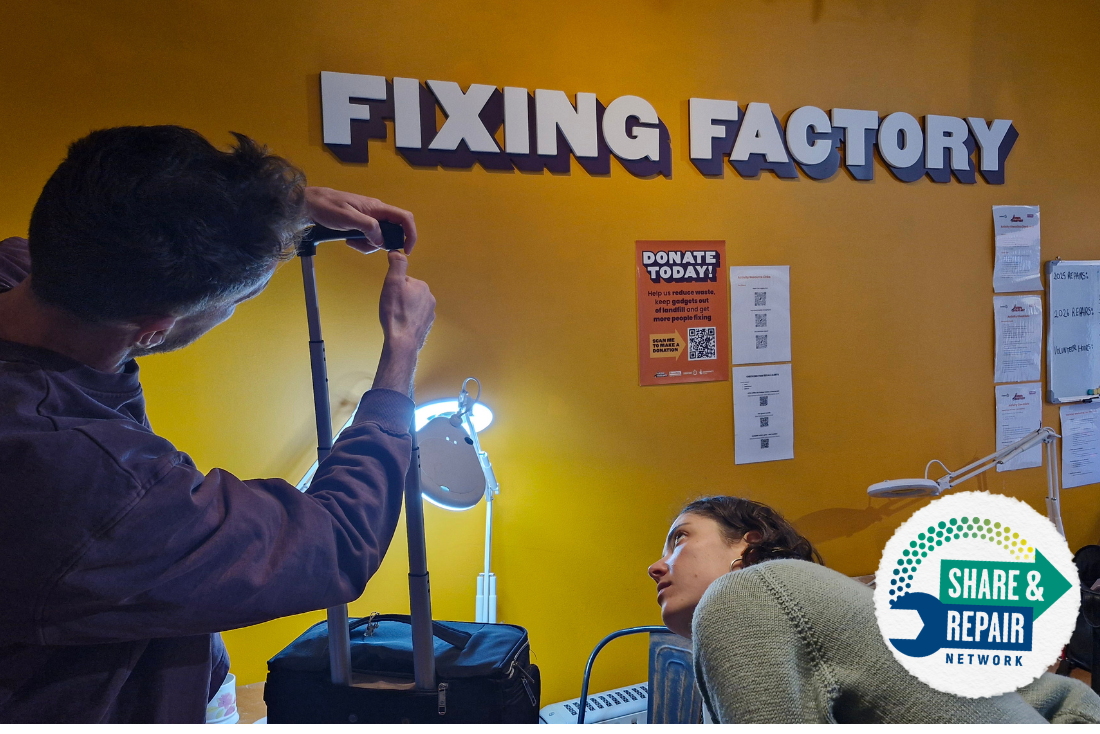
On a recent trip to London Share & Repair Network Coordinator Jane Owens had the opportunity to visit Hackney Fixing Factory. The Hackney location is one of five Fixing Factories now in operation across the capital city, “tackling e-waste head-on with a mix of hands-on repair sessions, skill-building workshops, and a big dose of community spirit.”
The visit offered valuable insight into Fixing Factory’s approach to running high‑street repair spaces which aim to make community repair visible and accessible.
Like fixed repair spaces in Scotland (including the General Store in Selkirk, Linlithgow Repair Shop and the Edinburgh Remakery) Fixing Factory brings community repair to the high street. Alongside reducing waste by fixing rather than replacing, empowering communities through sharing hands‑on repair skills is at the heart of Fixing Factory’s mission, with a tag line “Making repair easy, accessible and fun for everyone”.
Supported by three‑year funding from the National Lottery Community Fund, Fixing Factory is a large‑scale partnership between The Restart Project and Possible, combining grassroots repair expertise with strong communications and campaigning experience.
Fixing Factories provide an array of opportunities for people to get items repaired, learn repair skills, or volunteer as a fixer.
For the public
Free weekly Community Repair Sessions operate in a similar way to repair cafés, with an emphasis on skill‑sharing. Some locations also offer a paid Repair Drop‑off service.
For people interested in more in‑depth learning, Fixperience workshops include three‑hour sessions such as Toaster Teardown and Solder On. There is also an eight‑session Fix It Yourself course, with many participants going on to become volunteer repairers.
For volunteers
Volunteer roles and progression routes are clearly defined, with training available from beginner to expert level. Volunteer fixers support all types of repairs, from Community Repair Sessions to regular Repair Club sessions where drop‑off items are fixed.
Future Fixers sessions offer structured learning modules for long‑term volunteers, covering electrical safety, PAT testing, and how to safely repair a wide range of electrical items. The focus is on building confidence alongside practical skills.
A key challenge for the Fixing Factories is developing a long‑term sustainable business model.
National Lottery funding has enabled the project to experiment with different approaches to charging for services and workshops.
As Fixing Factory Lead for Restart, Arthur Shearlaw explains:
“It’s very much been a trial‑and‑error process of working out what format works best and what prices are acceptable.”
The aim is to strike a balance between remaining accessible and generating income to support long‑term sustainability.
Pricing varies across the different activities. Community Repair Sessions are free, although people can pay £5 to book a guaranteed time slot. Repair Drop‑offs involve a variable, non‑refundable assessment fee, with each repair priced individually. Workshop fees range from £35 to £65, while the full Fix It Yourself course costs £140. All bookings include the option to add a donation to support running costs.
Additional income is generated through the resale of some repaired items. In Hackney, this is delivered in partnership with a local charity shop, with profits split 50/50. The project has also explored corporate volunteering, team building days and sale of “off-the shelf” ready to use workshop packages, complete with slides, lesson plans, and trainer support.
While all repairs are carried out by volunteers, training and project management are delivered by paid staff. By the end of the three‑year funding period, the aim is to demonstrate that a significant proportion of running costs can be met through self‑generated income, although funding to support core costs will continue to be essential.
The Fixing Factories partnership brings together complementary strengths.
Both Restart and Possible are active in campaigning, while Restart contributes deep expertise in community repair. Possible, as a larger organisation, brings strong marketing, communications and PR capacity.
Possible is responsible for the project’s distinctive branding and design, as well as its communications strategy. This has helped secure high‑profile media coverage since the launch two years ago, including features on BBC London and in The Guardian.
Two new Fixing Factories opened in spring 2026 in Barking and Westminster.
Learning from experience to date, these new locations are more scaled back, supporting the project’s ambition for the Fixing Factory model to be replicable and scalable. Rather than operating as standalone venues, the new sites are embedded within buildings where repair and reuse initiatives are already established, helping integrate repair into existing community infrastructure.
Share and Repair Network Coordinator Jane Owens said:
“It’s always inspiring to see how other repair organisations operate, particularly outside of Scotland. Fixing Factory has really shown that scaling for repair projects is possible in dense cities like London, particularly with the power of collaboration between different projects and organisations with their own set of skills and attributes. In Scotland, we’re always looking to grow our repairing projects and support them to reach the coveted high street spaces. I’ll be looking forward to taking what I learnt from this visit and sharing it with our membership.”
To learn more about our Share and Repair Network visit our webpage or email jane@circularcommunities.scot.