
Circular Communities Scotland is proud to be a member of RREUSE, as it gives us, on behalf of our members, a clear voice on a European stage on matters ranging from reuse targets and eco-design to the right to repair, product standards, and more.
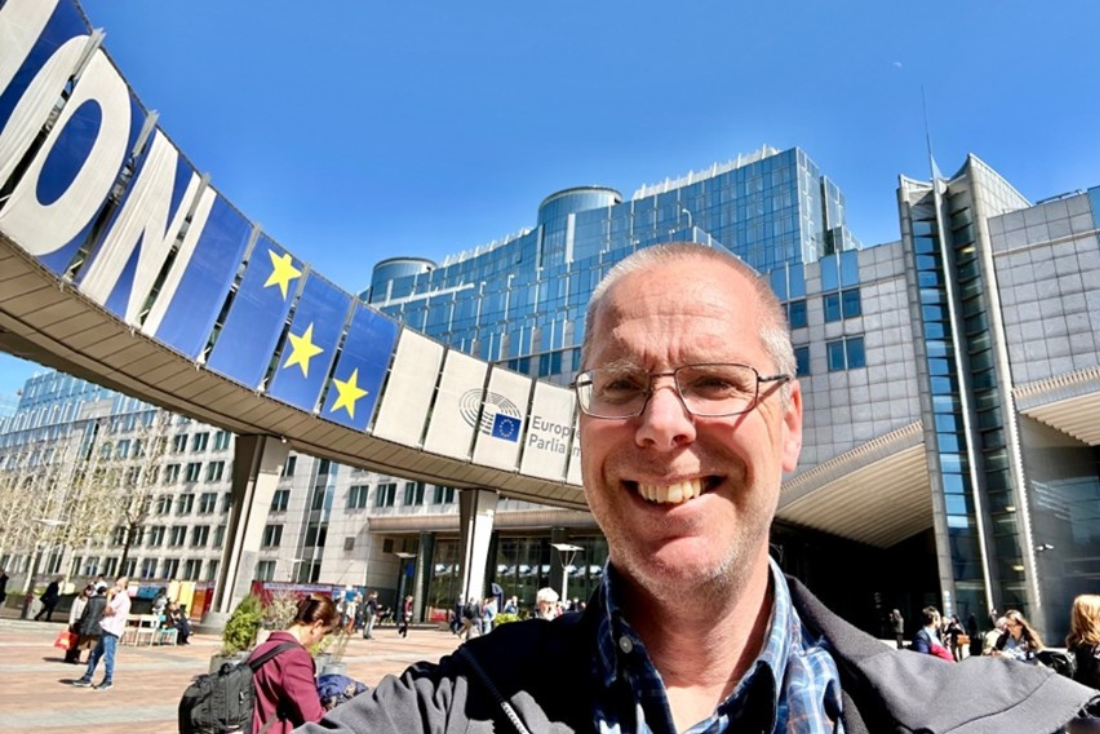
Last week our CEO Michael Cook visited Brussels for his final meeting as a member of the RREUSE Board. RREUSE was celebrating its 25th birthday which was marked in the European Parliament. MEPs from several parties were in attendance and there were strong panel sessions on key policy areas.
Michael reports on key issues relevant to our members, below.
Repair
Right to Repair legislation was passed in the previous EU mandate. These laws do not directly apply in the UK, but needless to say, products designed for Europe are certainly sold here, so we do benefit from the increasing repairability of new products.
The focus has now moved on to eco-design and product passports.
Eco-design is the new framework for product standards, designed to ensure that products minimise their impact on the environment. This includes the use of recyclable materials, durability, repairability, banning paired parts (that cannot be used again), labelling requirements, and more. The first two product streams to go through the new eco-design process are textiles (likely by 2027) and electronics (likely by 2028). The UK will benefit from these new design standards.
Once eco-design has been completed for a product stream, new products sold will have a product passport. This will be rolled out in Europe for textiles and electronics. Essentially, every product will have a way of uniquely identifying it (a QR code or RFID chip). This will link to an online database where a buyer can see certain information, and a legitimate interest group (e.g., a Repair Cafe) can too. Information should include common faults, repair options, spare parts, etc. The detail still has to be worked out, but it could be positive for repairability. Note that these laws, again, do not apply in the UK, but no doubt some of these products will be sold here, and if the UK wants to align with Europe’s market, we will need a similar scheme here.
Reuse
-
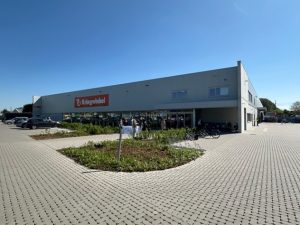
- Kringwinkel – outside the 8000m2 shop
-
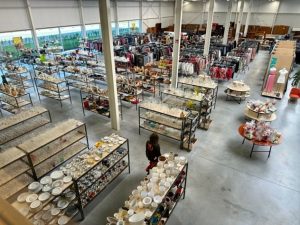
- shop interior
-
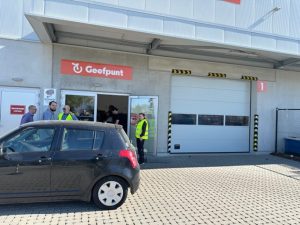
- customer donations area
A highlight of Michael’s trip trip was a half-day site visit to Kringwinkel. This is a charity that runs reuse shops at a significant scale above what we have in the UK. They run 12 large shops and four sorting hubs, serving an area with a population of 850,000 people. They collect 14,000 tonnes a year for reuse. Michael found several things about this organisation inspiring, demonstrating what can happen with strong local and national government support.
- First, they own their buildings, which are purpose-built and state of the art.
- Second, government support has been there, with up to 50% of their salary bill paid for through employability grants.
- Third, they operate fantastic systems.
Michael shared details of their sorting and pricing strategy.
Sorting
All products are sorted up front. Those that cannot be reused locally are sent for recycling and/or reuse elsewhere. Everything else is processed through a spacious, state-of-the-art sorting hub with various demarcated working areas (bikes, small electrics, white goods, toys, textiles, bric-a-brac, etc.). Corks and candles are separated as they have a different market. For toys, they have trays of spare parts for Lego and Playmobil to complete sets, which they sell online for higher prices. This is made economically possible because of the space, quality of the system, and employment subsidy.
Pricing
For pricing they have a premium brand called Chique Dinges, which has its own area of the shop, its own labelling, and stronger warranties; this is for the very best products only. The remainder are priced at 10-20% of the new price, using standard pricing tables (€3 for a T-shirt, €6 for a dress, for example). Each product going onto the shop floor has a coloured tag identifying the week it was put out. After three weeks of not selling, the price is halved and it is moved to a sale area. After one further week, it is taken off the shop floor and goes instead to a kilo shop in an economically deprived part of Brussels, where all products are sold by kg at very cheap rates. This system means fairly unskilled staff can price products (even if they don’t speak the language thanks to picture guides for everything), and all products move through the shop within a month.
Michael shares his reflections on his trip to Kringwinkel –
“What I found inspiring was that strong government financial support has enabled Kringwinkel to own their premises. This, in turn, has enabled them to refine processes over time and implement continual improvements. They collect 16 kg per head of population in the area they operate which is well above the 8 kg government reuse target. Their collection service is paid for by local authority contracts, and they are paid more for higher levels of reuse. The increased income can then be fed into investments to deliver even greater levels of reuse.
Scotland’s policy makers could learn a lot from this, and support greater levels of reuse by establishing:
- Ambitious reuse targets
- Strong employment subsidy support
- Local authority contracts for reuse that pay more for higher reuse levels
- Priority for social enterprise contracts and social impact results (job creation)”
For more information on the RREUSE network visit RREUSE | Putting Second-Hand First
To find out how to feed into and keep in touch with our policy work contact our Circular Economy Policy Officer, Becky Kenton-Lake – becky@circularcommunities.scot